Back

Product · Rotary motion

Gear Shafts

Integral gear shafts, spline shafts, motor shafts, and stepped shafts — built to your drawing.

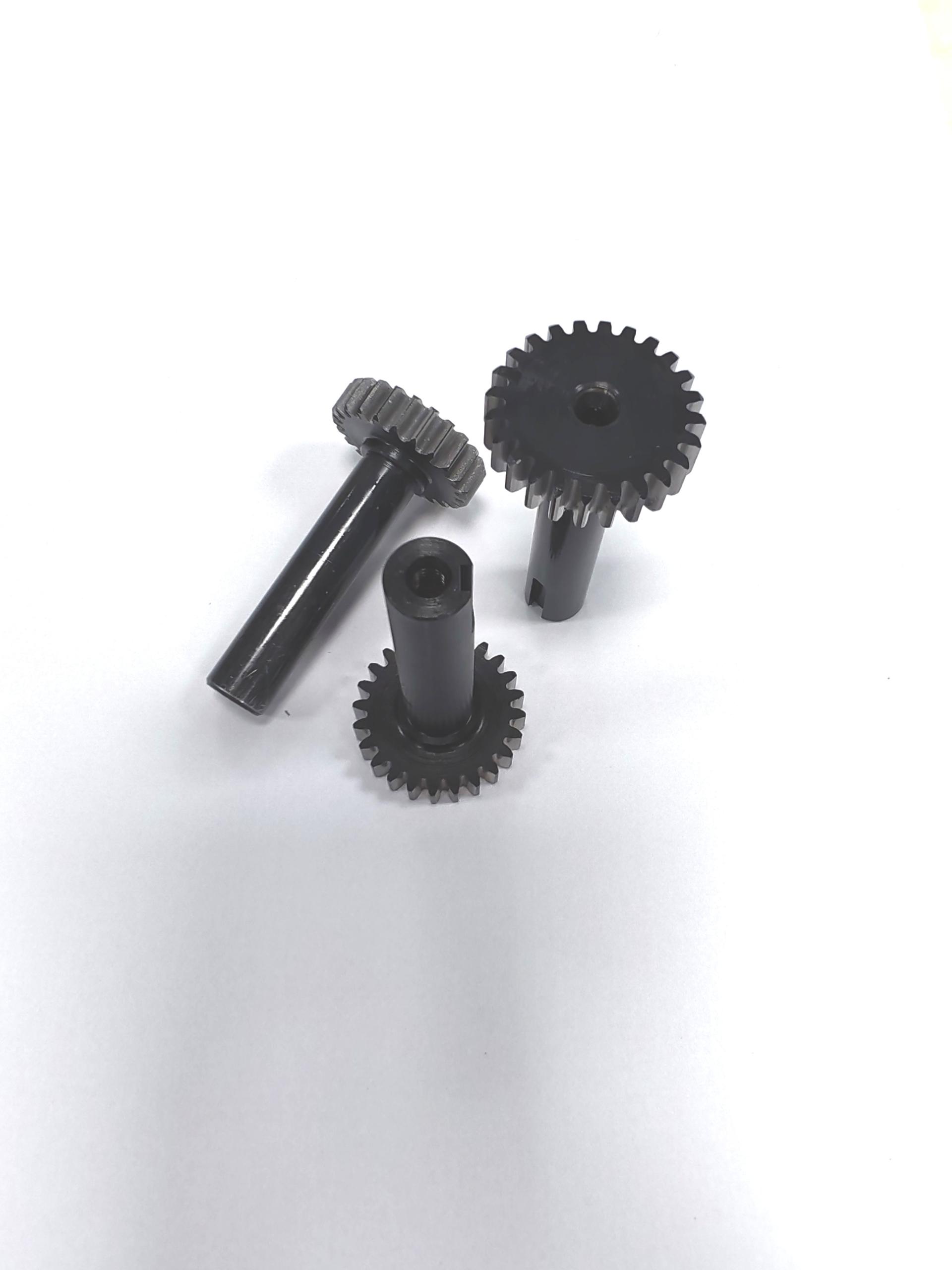
When a gear is cut directly onto the shaft body, you eliminate a keyed joint, an interference fit, and a runout stack-up. Wolfer manufactures integral gear shafts — and the related families of spline, motor, and stepped shafts — from quenched-and-tempered or case-hardened steels, ground after heat treatment.

Gear Shafts

What we make

Gear Shafts we cut from drawings.

One-Piece Gear Shafts

One or more gear sections cut directly into the shaft body

Spline shaft

Involute (ISO 4156 / ANSI B92.1) or straight-sided (DIN 5462 / 5463) splines

Motor shaft

Custom motor shaft extensions, with encoder bores and keyways

Ball-screw end machining

Ball-screw shaft ends machined to your drawing

Stepped shaft

Multi-diameter shafts for bearing stack-ups

A "gear shaft" can mean three different things to three different engineers — Wolfer covers all three. (a) Integral gear shaft: a gear cut into the shaft body, no key joint. (b) Spline shaft: standard or custom involute / parallel-key splines. (c) Stepped / motor shaft: turned, ground, and balanced to fit a specific motor frame.

Critical surfaces (bearing journals, gear pitch diameter, spline major / minor diameter) are ground after heat treatment. Total indicated runout (TIR) on bearing journals is typically held to ≤ 0.01 mm (0.0004 in). Surface roughness on ground journals is Ra 0.4 µm (16 µin).

We balance long shafts on a two-plane dynamic balancer when the customer drawing calls for it — typical balance grade G2.5 per ISO 1940.

Standards

Built to international tolerance specs.

  • ISO 4156 (involute spline)
  • DIN 5462 / 5463 (parallel spline)
  • ISO 1940 (dynamic balance)

Inspection

Every part measured before it ships.

  • Between-centers runout check on precision bench centers
  • CMM — concentricity of gear pitch-diameter to bearing journals
  • Dynamic balancing machine (Haimer / Tonsong)
  • Surface roughness tester

Applications

Where these parts go to work.

FAQ

Common questions from engineers buying this product.

Why choose an integral gear shaft over a separate keyed gear?

Two reasons: backlash and runout stack. An integral gear has no keyway clearance, so backlash is determined only by tooth-flank tolerance. And the gear pitch diameter is cut concentric to the same centers as the bearing journals, so total runout is the lowest you can get without a flange-mount bearing.

Can you supply a shaft with two different gear modules?

Yes — we routinely make double-gear shafts where the input pinion is m 1.5 and the output pinion is m 3. Both sections are hobbed and ground after heat treatment in the same setup.

Related products

Often quoted together.

Ready to start your gear shafts project?

24-hour quote · engineering review within one business day · ≤ 30 days to ship after approval.

This is a preview of the Gear Shafts product page

return to home preview

preview build